
Bank Rate has been 3.75% since 18 December 2025. The Bank of England decides again on 5 November. In a Reuters poll of 63 economists taken between 12 and 14 October, 54 expected a quarter point rise, and the same report said markets were fully pricing four quarter point rises by the end of 2027.
I am not going to tell you what happens next. I stopped forecasting rates earlier this month and I do not miss it. The more useful question is what a rise does to the rate on your own business cash, because last time there is real data to look at.
What happened last time
Between January 2022 and November 2023, Bank Rate went from 0.25% to 5.25%, a rise of five percentage points. Each month the Bank of England publishes the average rates that UK banks and building societies actually charge and pay private companies. Here is what those averages did.
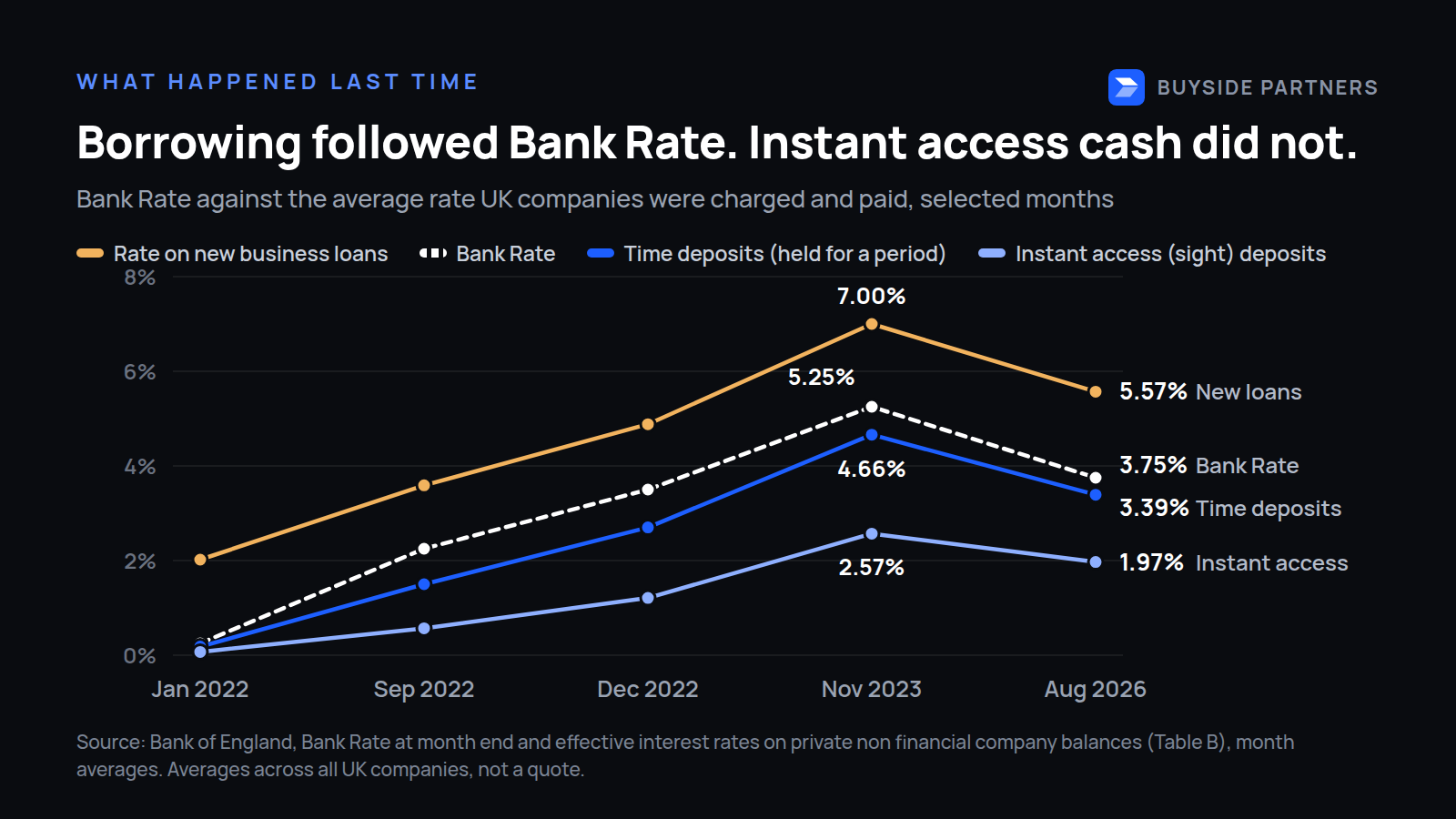
Bank Rate at month end, and average effective rates on private non financial company balances, selected months. Source: Bank of England.
Borrowing moved with Bank Rate. The average rate on new business loans went from 2.02% to 7.00%, up 4.98 points. Close to the whole rise.
Time deposits moved most of the way. The average rate on time deposits went from 0.18% to 4.66%, up 4.48 points. About nine tenths of the rise.
Instant access deposits moved half. The average rate on sight deposits, money repayable on demand, went from 0.07% to 2.57%, up 2.50 points.
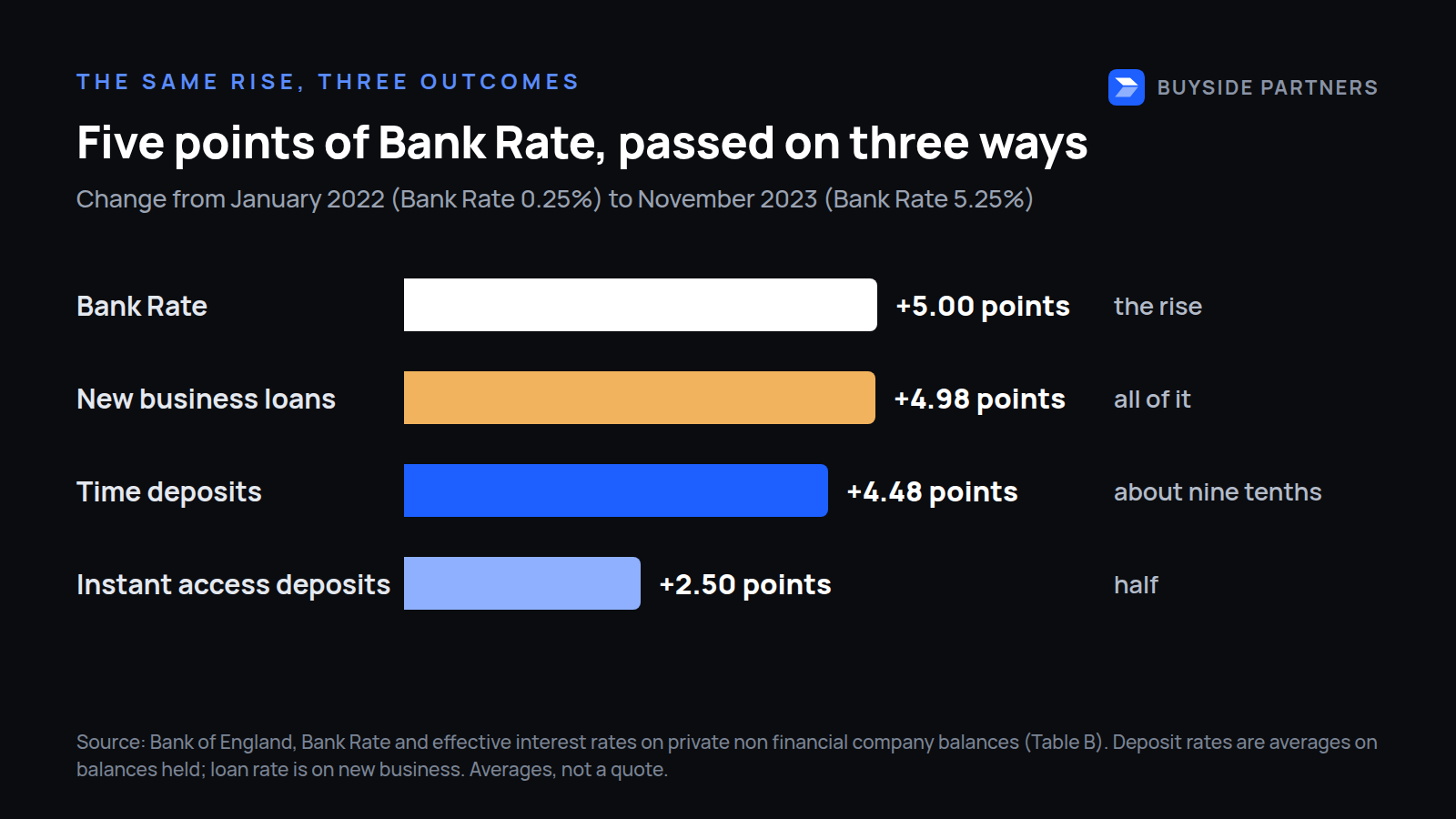
The same five point rise, passed on to borrowers in full, to time deposits by about nine tenths and to instant access deposits by half.
Nothing in the data says anyone behaved badly. It says what happened. Money that can leave tomorrow was repriced by less than money placed for a period, and borrowers saw almost all of the rise.
It also took time
By December 2022, Bank Rate stood at 3.50%. The average instant access rate paid to companies that month was 1.21%, and the average time deposit rate was 2.70%. The instant access average did not pass 2.5% until September 2023, by which point Bank Rate had been 5% or more since June.
Why the type of account matters
A fixed or notice deposit is priced on the day you open it, using the rates on offer that day, and any rises the market expects tend to be in that price already. An instant access balance has no such date. It is repriced whenever the provider chooses to, and last time that was later and by less.
That is why the account can matter as much as the bank. The middle ground is covered in our piece on the 95 day notice account.
Where things stand now
The latest Bank of England figures are for August 2026, with Bank Rate at 3.75%. Instant access balances earned an average 1.97%, which is 1.78 points below Bank Rate. Time deposits earned 3.39%, 0.36 points below. New business loans cost 5.57%, 1.82 points above.
Those are averages across every UK private company, including very large ones. A smaller business on default terms may well earn less than the average. Treat them as the shape of the market, not as your rate.
What that is worth on £500,000
At August's averages, £500,000 earns about £9,850 a year on instant access and about £16,950 on time deposits, a difference of £7,100.
Now suppose Bank Rate rose by one point and the last cycle repeated. Instant access would pass on about half a point, which is £2,500 a year. Time deposits would pass on about nine tenths of a point, which is £4,500. The gap would widen by £2,000 for every point.
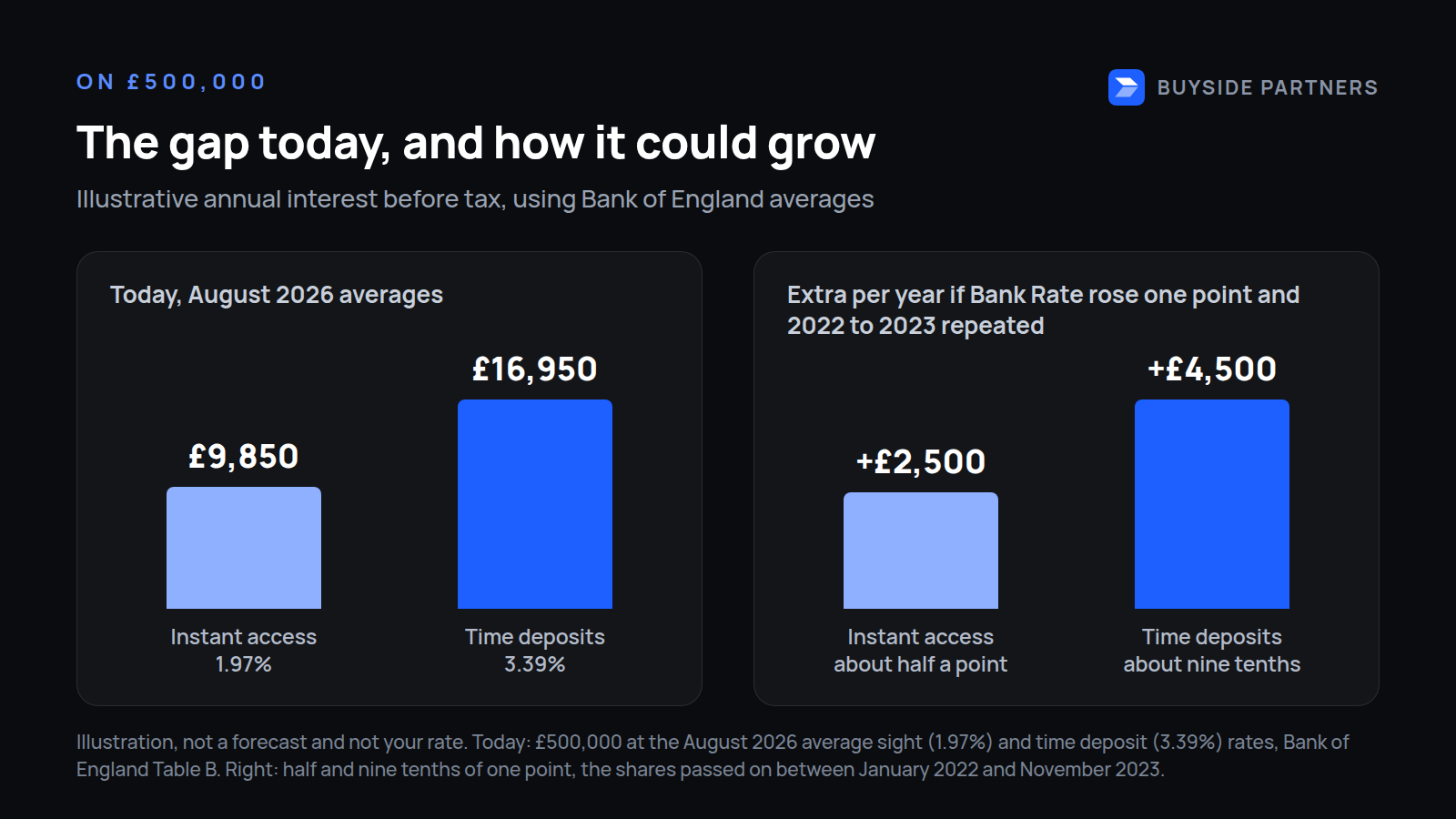
Illustration, not a forecast and not your rate. The next cycle can pass through differently.
What to check before 5 November
This is preparation, not prediction. Whatever the Bank does, three checks are worth an hour.
What each balance earns today. By account, not by bank. Most businesses can name the bank and not the rate.
How much of it needs to be instant. The balance you never fall below across three months of statements is the layer that can sit still. Our sector by sector piece puts pounds on it.
What you would do either way. If the rises land, notice and fixed rates probably reflect them already. If they do not, today's rates may look good in hindsight. Instant access cash is the part that trails in both cases.
How this works with us
Buyside Partners is an independent intermediary, never a broker holding your money and never the counterparty. We compare what a panel of assessed providers would pay on your shape of cash, introduce you to the right one, and stay alongside. The provider pays us, so there is no cost to you.
Three questions we hear every week
Will my bank raise my rate by itself if Bank Rate goes up? Possibly, in time. Last time the average instant access rate paid to companies rose by half of the Bank Rate rise and took until September 2023 to pass 2.5%. Check your own statement rather than waiting for a letter.
Should I wait for the decision before fixing? The rises markets expect are normally already inside fixed and notice rates, so waiting for the headline often means waiting to be offered what was on the table. If the rises land, today's rate was fair. If they do not, it was a good one. This is general information, not personal advice.
What does it cost to compare? Nothing. The provider pays us on placement. If we cannot beat what you already earn, we say so and you have lost ten minutes.