
Not knowing your deposit rate is not carelessness. It is how defaults work. The current account was opened years ago, the savings account was whatever sat beside it, and the rate on both was never the thing anyone was hired to watch. Meanwhile Bank Rate sits at 3.75% as this is written, and the gap between what business cash earns by default and what it could earn when compared across a panel has rarely been worth more.
The numbers below are illustrative arithmetic, not quotes. Two percentage points is a useful working figure for a business that has never compared; your own gap may be smaller or larger, and the whole point is to find out which.
The arithmetic nobody runs
Take the spread between what your cash earns today and what a compared rate would pay, multiply by the balance, and that is the annual cost of not asking.
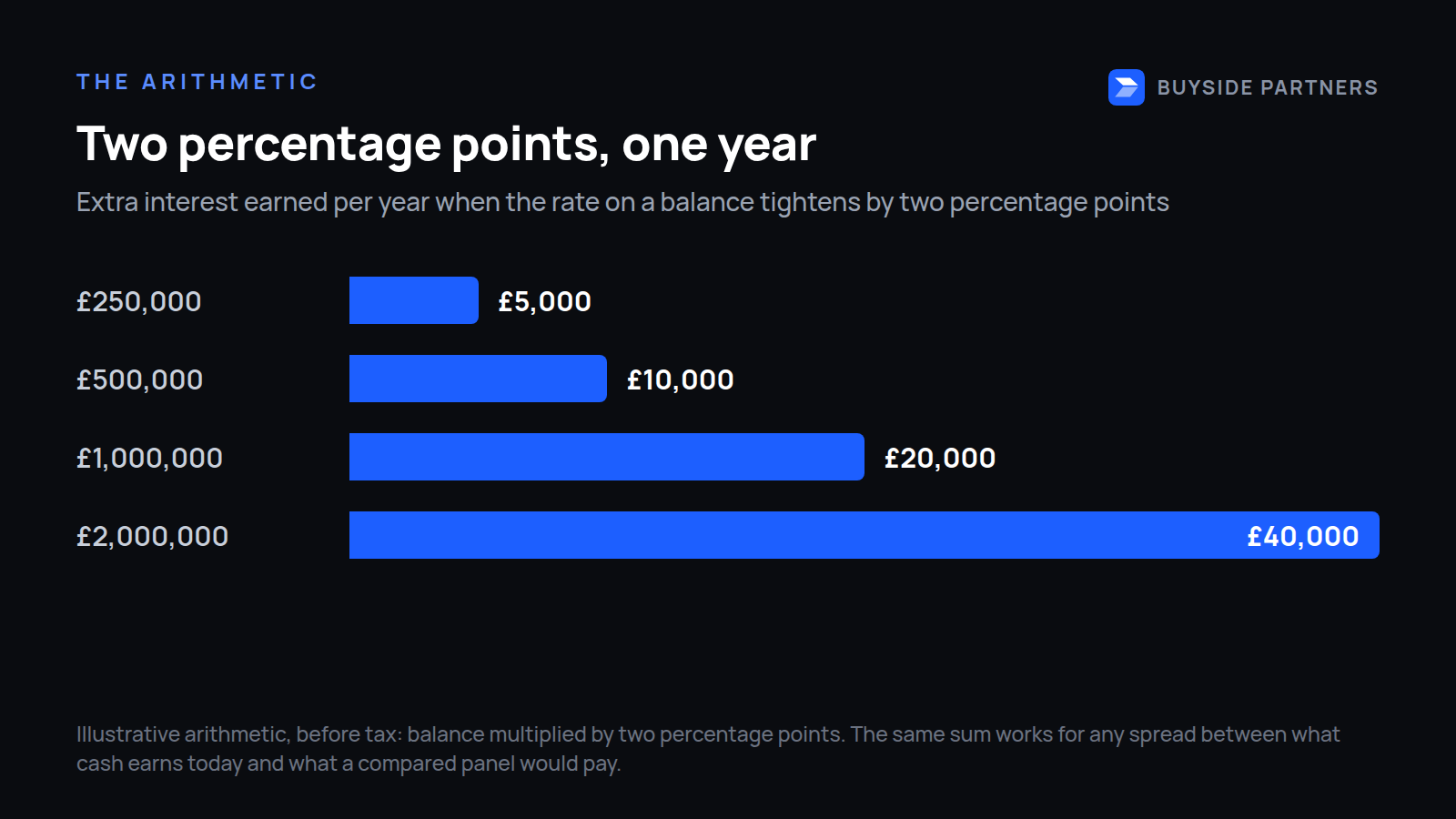
Illustrative and before tax: balance multiplied by two percentage points. The same sum works for any spread.
The line that matters: the arithmetic is linear. Half the spread, half the money. Double the balance, double the money. There is no clever threshold, which is exactly why it gets ignored. No invoice ever arrives for interest you did not earn.
Where the still layer sits in each sector
The rate only works on cash that can sit still. Every sector holds a different shape of it.
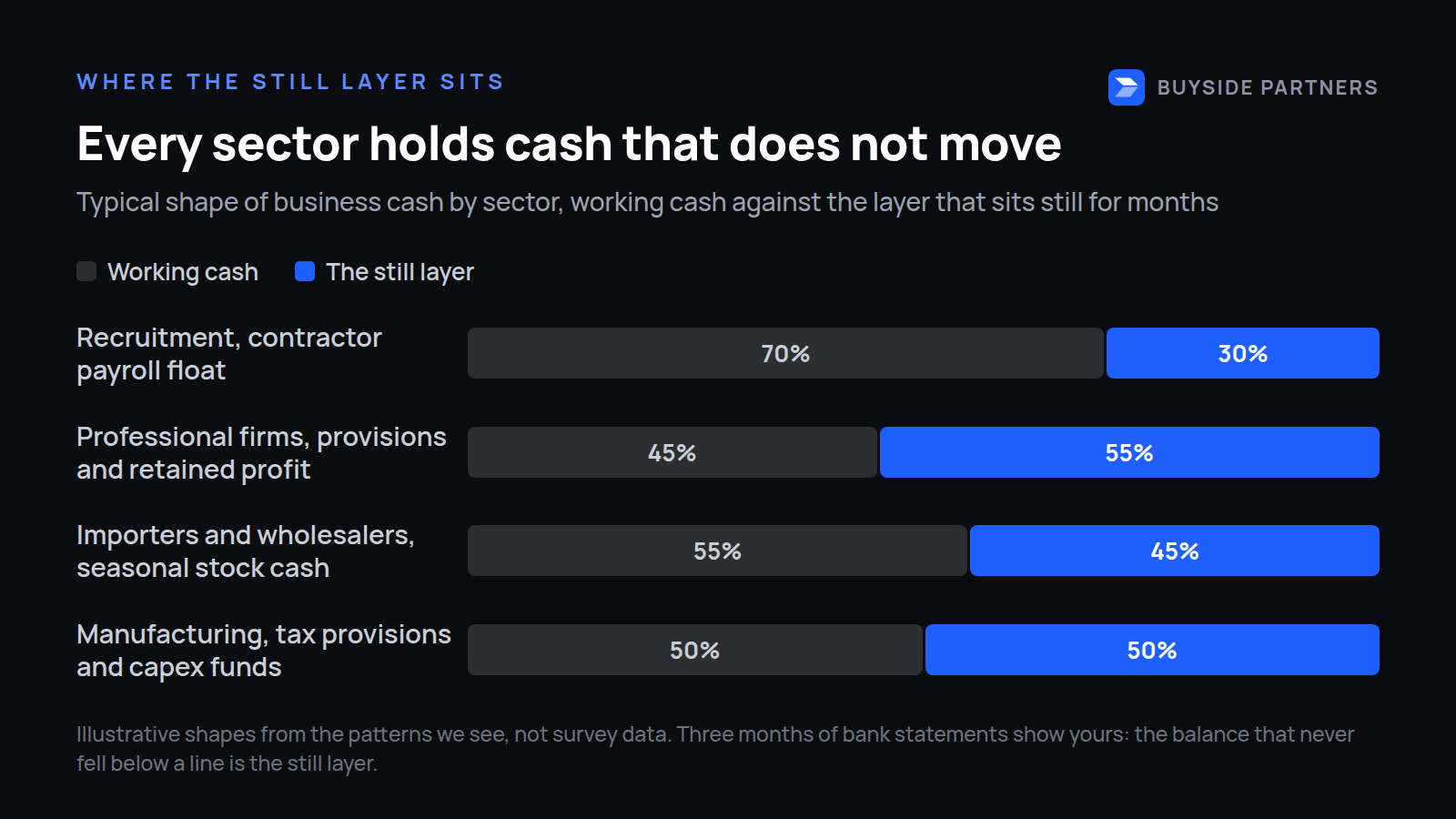
Illustrative shapes from the patterns we see, not survey data. Three months of bank statements show yours.
Recruitment. A 150 seat agency running contractor payroll holds a serious float, and most of it genuinely has to stay instant. But the week to week trough rarely touches zero. The balance the float never falls below is structural, and on a £400,000 trough a two point spread is £8,000 a year for one afternoon of paperwork. Contractor margins are thin; £8,000 is a consultant's quarter.
Professional firms. The shape here is provisions: partner tax set aside months before it is due, retained profit waiting on a distribution decision, a sinking fund for the office move. This is the stillest cash in business, often half the balance, and it usually earns the least because it sits in the firm's oldest account. A firm holding £750,000 of provisions at a two point spread leaves £15,000 on the table every year. To be clear, this is the firm's own money, not client account money, which lives under its own rules.
Importers and wholesalers. Cash here breathes with the season: it piles up after the spring sell through, sits still through summer, then converts to stock in autumn. The layer is predictable months ahead, which makes it ideal for notice periods, yet it usually waits in the current account because the buying date feels close. It rarely is. £500,000 sitting still for eight months at a two point spread is roughly £6,700, about the cost of shipping a container for free.
Manufacturing. VAT collected but not yet paid, corporation tax accruing through the year, the capex fund for the machine arriving next spring. All of it has a diary date, and dated money is the easiest to place well because the maturity can land the week the payment leaves. A manufacturer cycling £600,000 of provisions at a two point spread is £12,000 a year, which is most of an apprentice.
Why businesses do not move
Three reasons come up every time. The rate feels official, as if the default were set by someone neutral. It is not; it is priced on the assumption you will not ask. Moving feels like admin, though in practice the comparison takes a statement and the switch takes a form. And nobody owns the question, because the FD watches margin and the bank watches itself.
The structure that fixes it
You do not fix this by chasing the best rate once. You fix it by giving each layer of cash a job.
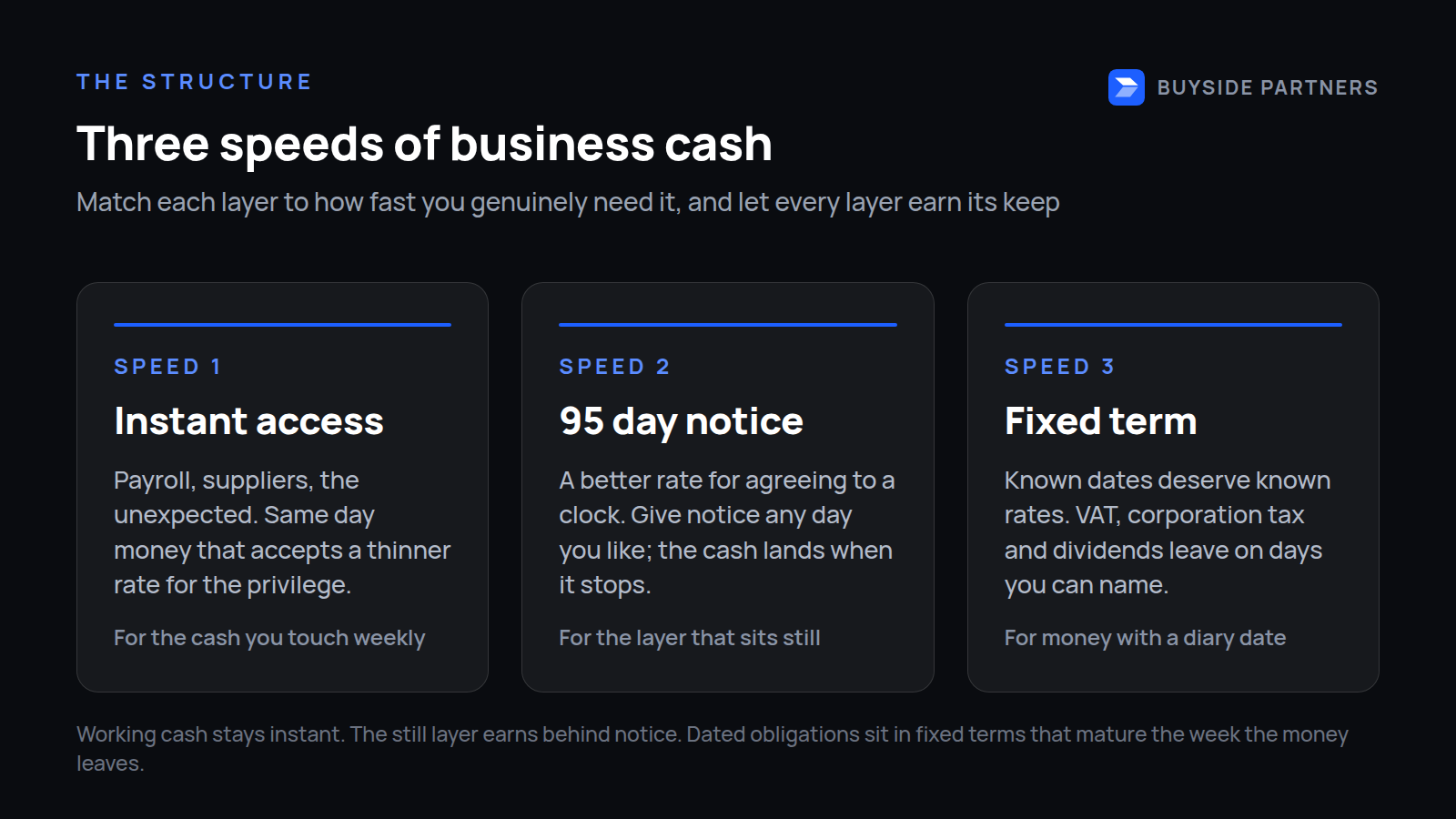
Working cash stays instant. The still layer earns behind notice. Dated obligations sit in fixed terms.
Working cash stays instant and accepts a thinner rate for it. The still layer earns properly behind a notice period, and if 95 days sounds long, the detail most businesses have never been offered is that you can give notice on day one; the full explanation is in our piece on the 95 day notice account. Dated obligations sit in fixed terms that mature the week the money leaves.
Since December 2025, FSCS protection covers £120,000 per depositor per banking licence, so spreading the layers across a panel of providers does two jobs at once: the exposure shrinks and the rate improves.
How this works with us
Buyside Partners is an independent intermediary, never a broker holding your money and never the counterparty. We compare what a panel of assessed providers would pay on your shape of cash, introduce you to the right one, and stay alongside. The provider pays us, so there is no cost to you.
Three questions we hear every week
How much cash does this need to be worth doing? If the still layer clears six figures, the arithmetic above says the conversation pays for itself many times over. Below that, it is still worth one email to find out.
Is our money locked up? No. Working cash stays instant. Notice money is never locked; the clock simply runs from the day you give notice. Fixed terms are chosen to mature when the money is needed.
What does it cost? Nothing. The provider pays us on placement. If we cannot beat what you already earn, we say so and you have lost ten minutes.